The Joint R&D Center for Polymer Compounding and Modification Equipment, jointly established by KYMACH Equipment and Beijing University of Chemical Technology, has recently made progress in the study of twin-screw extrusion devolatilization.
The two parties carried out a systematic experimental study on the optimization of devolatilization in twin-screw extrusion, focusing on the relationship between equipment operating conditions and the process window for reducing volatile residues in polymers.
The work reflects KYMACH's accumulated experience in continuous polymer processing equipment while providing a practical approach for studying and optimizing devolatilization processes.
During polymer processing, residual monomers, solvents, oligomers, and other low-molecular-weight volatile components can directly affect material odor, thermal stability, processing safety, and subsequent application performance.
Achieving stable reduction of volatile residues under continuous production conditions is therefore an important process challenge for many polymer processing applications.
A twin-screw extruder combines continuous conveying, melting, mixing, dispersion, and enhanced mass transfer within a single processing system. The continuous renewal of the melt surface through screw-element movement, together with the formation of a favorable interface in the vacuum section, can support the continuous removal of volatile components from high-viscosity polymer systems.
Based on its experience in twin-screw extruder design and manufacturing, KYMACH worked with Beijing University of Chemical Technology to conduct systematic experiments aimed at converting these equipment characteristics into measurable and reproducible process capabilities.
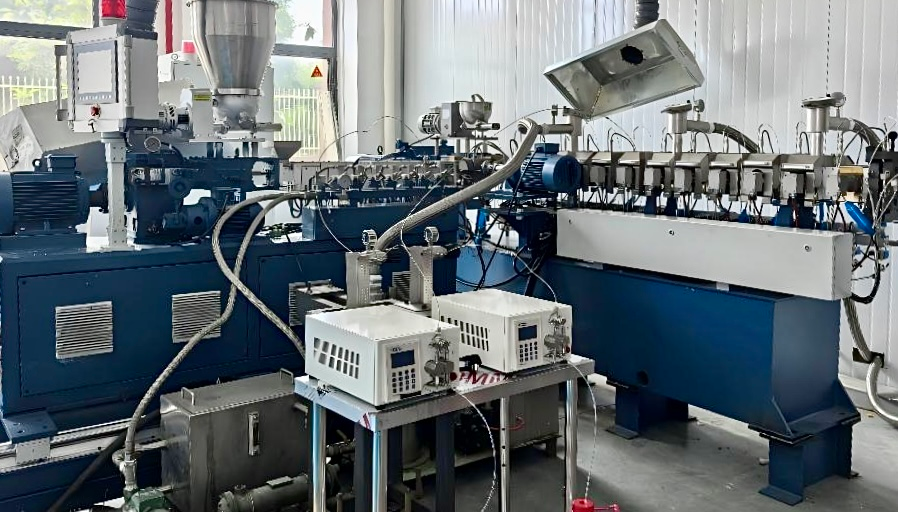
The study used an experimental design approach and focused on three process parameters that can be adjusted relatively directly during production:
l Screw speed
l Barrel temperature
l Feeding rate
l The experimental ranges were:
l Temperature: 210–230 °C
l Screw speed: 200–300 rpm
l Feeding rate: 10–20 kg/h
The objective was to minimize volatile residues as far as possible under continuous processing conditions.
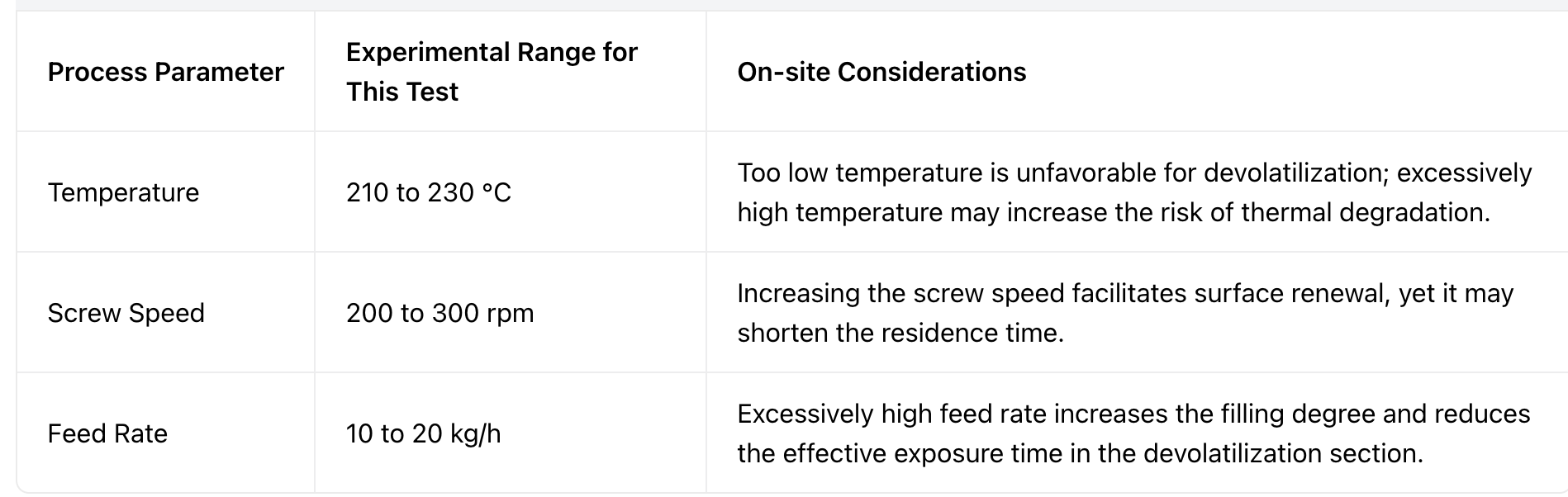
The experimental results provided three important observations.
Increasing the feeding rate can improve equipment utilization and production throughput, but it also reduces the effective exposure time of the material in the vacuum section.
This means that the feeding rate needs to be balanced against the required devolatilization performance.
Increasing temperature can reduce melt viscosity and improve the migration of volatile components.
However, excessively high temperatures may increase the risk of thermal degradation or unwanted side reactions.
The appropriate operating temperature should therefore be determined according to the material characteristics and equipment operating conditions, rather than simply increasing the temperature to obtain stronger devolatilization.
The experiments indicated a clear Interactive effect between screw speed and temperature.
Increasing screw speed can generally enhance mixing and melt-surface renewal. However, when the temperature is already relatively high, simply increasing screw speed does not necessarily continue to reduce the residual volatile content.
During commissioning, these two parameters should therefore be considered together rather than adjusted independently.
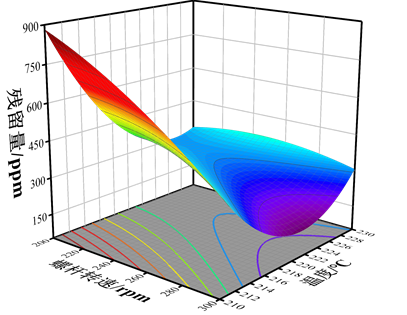 Interactive effect of temperature and screw speed
X-axis: Screw speed, rpm
Y-axis: Processing temperature, °C
Z-axis: Residual content, ppm
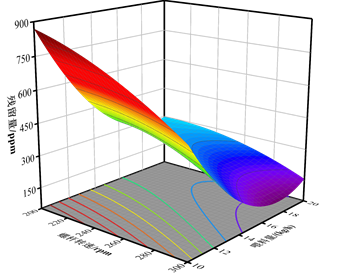
Interactive effect of screw speed and feeding rate
X-axis: Screw speed, rpm
Y-axis: feeding rate
Z-axis: Residual content, ppm
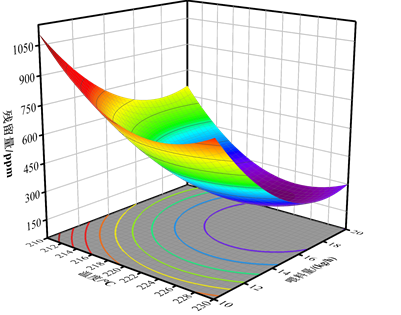
Interactive effect of temperature and feeding rate
X-axis: Processing temperature, °C
Y-axis: feeding rate
Z-axis: Residual content, ppm
The response-surface analysis provides a more direct view of the interaction between different process parameters.
The response surface showed a region of relatively low residual content around lower temperatures combined with higher screw speeds within the experimental range.
This indicates that process optimization should not focus on a single parameter alone. The interaction between operating parameters also needs to be considered when establishing a suitable process window.
The analysis of screw speed and feeding rate showed that the effect of feeding rate was not simply linear.
Within the experimental range, increasing the feeding rate initially improved the result but subsequently led to a deterioration in devolatilization performance, indicating the existence of a more suitable feeding-rate range.
Screw speed showed an overall tendency toward reducing residual content within the tested conditions. Both parameters can therefore be optimized within the applicable experimental range.
The interaction between temperature and feeding rate also showed noticeable nonlinear behavior.
For practical production, this means that process parameters should not simply be increased or decreased without limitation. Instead, a stable operating window should be established based on the material characteristics, equipment configuration, and required production capacity.
The value of this research extends beyond obtaining a set of optimized parameters.
By analyzing how different process variables affect devolatilization performance, the study provides a more systematic approach to process optimization. Experimental design and data analysis can reduce reliance on repeated trial and error, help identify key process variables, and provide a basis for subsequent process scale-up, equipment commissioning, and production optimization.
During practical commissioning, a suitable combination of temperature, screw speed, and feeding rate can first be established within the experimentally validated range. The process can then be adjusted step by step according to material behavior, production requirements, and measured residual volatile content.
When the temperature is changed, screw speed should also be considered accordingly, rather than adjusting only one parameter while ignoring the interaction between the two.
For continuous polymer processing, stable devolatilization performance depends on the combined contribution of equipment capability, process window, and on-site validation.
Through the Joint R&D Center for Polymer Compounding and Modification Equipment, KYMACH will continue to translate experimental findings into practical process parameters and engineering solutions, supporting more stable production and consistent product quality.
KYMACH specializes in the development and manufacturing of twin-screw extrusion equipment and related process solutions. Its equipment is used in a range of applications including polymer compounding and modification, reactive extrusion, devolatilization, and solvent removal.
Through continuous technical development and cooperation with universities and research institutions, KYMACH continues to develop extrusion solutions designed for efficient, stable, and controllable polymer processing.
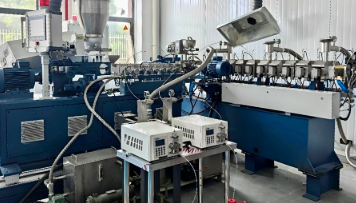 KYMACH and Beijing University of Chemical Technology Advance Twin-Screw Extrusion Devolatilization Research
Oct 09. 2026
KYMACH and Beijing University of Chemical Technology Advance Twin-Screw Extrusion Devolatilization Research
Oct 09. 2026
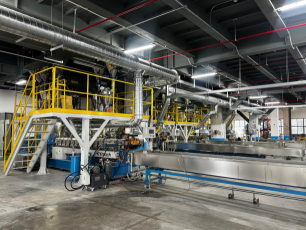 From Steel Platform to Production in One Month: KYMACH Delivers Six Compounding Lines for Zhejiang Jushen
Oct 09. 2026
From Steel Platform to Production in One Month: KYMACH Delivers Six Compounding Lines for Zhejiang Jushen
Oct 09. 2026
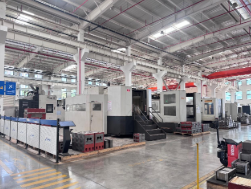 16 Sets of 125-Series Twin-Screw Extruders Ordered in Q3 2026: KYMACH Expands Its UHMWPE Fiber Equipment Track Record
Oct 09. 2026
16 Sets of 125-Series Twin-Screw Extruders Ordered in Q3 2026: KYMACH Expands Its UHMWPE Fiber Equipment Track Record
Oct 09. 2026
 10 Formulations Tested in 7 Days: KYMACH Supports Kazakhstan Customer with Comprehensive Material Trials
Oct 09. 2026
10 Formulations Tested in 7 Days: KYMACH Supports Kazakhstan Customer with Comprehensive Material Trials
Oct 09. 2026

Address : No.9 Chaoxiu Road Lishui Nanjing,Jiangsu,China
Email : info@kymach.com
website : www.kytwinscrew.com
website : www.keyatwinscrew.com